Heartland
Most of inland Australia cannot support permanent settlement of any scale. Water is scarce, power is expensive or absent, distance is punitive, and the coastal cities have absorbed the population growth that geography and infrastructure allowed. The corridor changes what is possible in the interior. Not by treating it as an energy resource to be extracted, but as ground that could hold towns, industry, and land regeneration if the underlying constraints are solved together.
The Reason for the Whole Thing
This is a proposal to change what parts of Australia can be lived in.
The technical case elsewhere on this site, the delivered cost advantage, the staged development, the Country consent as Gate 0, is the mechanism. This page names what the mechanism is for.
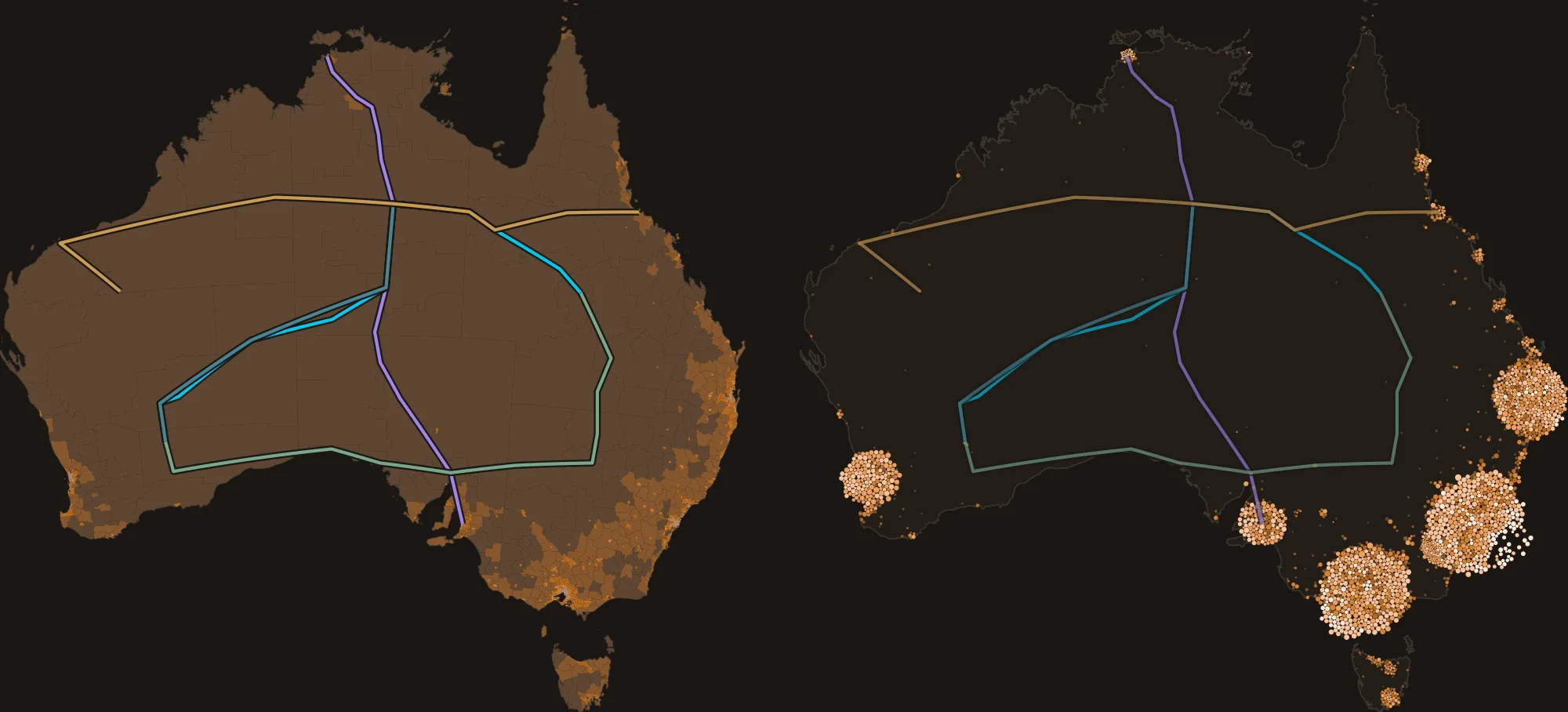
Australia is a continent of nearly 8 million square kilometres[1] holding 27.6 million people[2], with about 90 per cent of them living in urban areas[3]. Those areas are a sliver of the continent. Rank every square kilometre by how many people live in it, and the most crowded 0.24 per cent of the land holds nine in ten Australians[4]. A coastal strip currently under compounding pressure from housing scarcity, congestion, and heat. The alternative is not more density. The alternative is that the interior, given water and power at the right scale, can hold designed towns that a household would actually choose.
What a Corridor Town Is, and Is Not
A corridor town is not a fly-in mining camp, not a public-sector garrison, not a subdivision of Sydney relocated inland. It is a place designed from first principles to be worth living in.
The design pattern is a ring, three zones deep.
Outer ring
Solar generation, storage, desalination reservoirs, agriculture and regreening. Industrial-scale infrastructure sits here.
Middle ring
Data centre campuses, industrial processing, workshops, logistics. Heavy activity is deliberately separated from where people live.
Inner ring
Housing, schools, medical services, cafes, parks, water features, walkable streets. Residents experience the inner ring. The rest is out of sight.
The intent is that a household in the inner ring lives in a quiet place surrounded by nature. Cooled air, trees, water. While the systems that make the town viable operate at scale in the outer ring. Technology in the background, nature in the foreground. Scandinavian and Japanese in aesthetic reference, not desert-industrial.
Everything in the outer ring already has to exist for the cost case to work. The ring design just organises where it goes.
What the Corridor Enables at Scale
At 50 years, six to ten corridor towns of 5,000 to 20,000 people each, arranged 100 to 200 kilometres apart along the alignment eventually chosen. Each town powered by adjacent solar generation, watered by pipeline from coastal desalination, with local agriculture using desalinated water and shaded pedestrian cores. Approximately 100,000 to 200,000 people living in places that in 2026 could not support them.
At 100 years, a network of towns across the interior with mature regreening in the corridors between them. Wildlife biolinks, windbreak forests, artificial lakes seeded from desalination overflow, restored ecological function on land that in 2026 is degraded pastoral country or unmanaged desert. Population in the corridor of 500,000 to 1 million. The interior is no longer a place people fly over.
These timeframes are what current infrastructure build rates would deliver. They are not inherent to what the corridor is. The corridor’s timeline is a policy choice. The outcomes could arrive substantially sooner if the country decided to move faster than it currently does.
Both figures are indicative. They exist to give a reader something to hold, not because they are defended as forecasts. What matters is the shape. The corridor is a hundred-year proposition whose value compounds with each town added.
An Alternative to Coastal Concentration
The current trajectory has Australia’s population continuing to concentrate in Sydney, Melbourne, and southeast Queensland. The areas where infrastructure was built for a smaller country than the one now expected to fit into it. Housing costs, congestion, service overload, and climate exposure all follow from that concentration. Adding people to those cities is asked to solve a problem the geometry of those cities cannot solve.
The cost of this is felt most acutely across generations. In 1985 a first home in a capital city cost about three times a young worker’s annual salary. In 2026 it costs roughly nine to ten times an average income nationally — and twelve or more in Sydney.[5] What that ratio buys in practice is that a household in their twenties who wants to live near their parents cannot afford to, and a household in their sixties who wants to live near their grandchildren watches those grandchildren move to a different city because that is where the housing is. Family proximity has become a middle-class luxury.
A corridor town offers something the coastal cities cannot. The price and design conditions under which three generations of a family could plausibly live in the same town if they chose to. Cheap serviced land, purpose-built housing across price points, and jobs anchored to industries that could not previously exist inland. This is not a plan to depopulate the coast. Most Australians will always live where their families have always lived. It is a plan to give households who would choose otherwise a place to go, and to relieve the coast of pressure it should not have to carry alone.
Designed Rather Than Evolved
Sydney, Melbourne, and Brisbane evolved. They were laid down before cars, extended for cars, retrofitted for public transport, and are now being retrofitted again for density and climate. Every intervention argues with the intervention before it.
A corridor town would be designed. Which means it can take what other countries have already worked out. Japanese approaches to hygiene, public cleanliness, and quiet residential streets. Scandinavian approaches to urban layout, walkability, and daylight design. Swiss standards for public transport. Singaporean approaches to safety. Australian standards for open space and outdoor living. None of these are difficult in isolation. They are difficult to combine only when a city has already been built otherwise.
A corridor town has no such history. It can be designed to combine them from the start.
What the Corridor Is Not For
It is not a subsidy programme. If corridor towns cannot support themselves through the industries the corridor makes viable, they should not be built. The cost case is what makes this test passable.
It is not an evacuation of coastal Australia. Most Australians will always live where their families have always lived. The corridor is an addition to what Australia can be, not a replacement.
It is not a national character project. It does not depend on any particular political story about what Australia is or should be. The corridor's case rests on cost and physics. The argument for what it is for rests on what people would choose if the choice existed.
Sources
- Geoscience Australia, Area of Australia — States and Territories, 2024. link Accessed 2026-08. ACT = 2,358 km²; Australia 7.688M km².
- ABS, Regional population, 2024–25 — population estimates and components by SA2, 2026-03. link Accessed 2026-09. Estimated resident population at 30 June 2025 by Statistical Area Level 2. The 2025 estimates are preliminary and will be revised. CC BY 4.0. Re-run scripts/population when the 2025–26 release lands (due 25 March 2027).
- BITRE, An introduction to where Australians live — Information Sheet 96, 2018. link Accessed 2026-08.
- ABS, Australian population grid 2025 — Regional population, 2024–25, data downloads, 2026-03. link Accessed 2026-09. Modelled: SA1 population spread across residential address points, summed to 1 km² cells; the ABS says to interpret with caution. The concentration figures on /population (share of land holding half, and nine in ten, of the people) are TASC's calculation from this grid, not ABS statistics. Method at /population#method. CC BY 4.0.
- Finder, Owning a home in the 80s vs today, 2025. link Accessed 2026-08. 1984: 3.3× income; 2025: 9.4× national. TODO: supplement with ABS/CoreLogic series.